

Content curation software helps you gather, organize, and share relevant digital content with your team or audience. If you’re searching for the best platforms to keep your feeds fresh or your brand’s channels on-point, you know how challenging it is to cut through information overload.
Choosing the right content curation tool can help you avoid wasting hours sifting through sources and missing trends. In this list, you’ll find solutions that support real publishing workflows, boost collaboration, and help you make smarter decisions about what to share next.
Why Trust Our Software Recommendations
6,700+
Reviews
20
Industry experts
16+
Evaluation factors
14
Years
Our team has been testing and reviewing software since 2012. As publishers and media operators ourselves, we know how difficult—and important—it is to choose the right software.
For this guide, we evaluated tools using hands-on testing and independent research, scoring tools using our selection criteria.
Our reviews reflect our human editorial judgment, not a sales pitch.
Content Curation Software Comparison Table
This comparison table summarizes pricing details for my top content curation software:
| Tool | Best For | Trial Info | Price | ||
|---|---|---|---|---|---|
| 1 | Best for tracking industry trends in one place | Free trial available | From $1,600/month (billed annually) | Website | |
| 2 | Best for finding trending articles quickly | Free trial available | From $199/month (billed annually) | Website | |
| 3 | Best for social media team collaboration | 7-day free trial available | From $19/month (billed annually) | Website | |
| 4 | Best for user-generated campaign content | Free demo available | From $1,249/month | Website | |
| 5 | Best for AI-powered content recommendations | Free demo available | Pricing upon request | Website | |
| 6 | Best for newsletter curation with AI summaries | 7-day fee trial + free demo available | From $14.99/month (billed annually) | Website | |
| 7 | Best for sharing curated insights with marketing teams | Free trial available | From $49/month | Website | |
| 8 | Best for enterprise-scale social embed management | 14-day free trial | From $110/month (billed annually) | Website | |
| 9 | Best for annotating saved web content | Free plan available | From $5.99/month | Website | |
| 10 | Best for personalized news aggregation | Free plan available | Pricing upon request | Website |


Best Content Curation Software Reviews
Below are my detailed summaries of the best content curation software that made it onto my shortlist. My reviews offer a detailed look at the features, capabilities, and integrations of each platform to help you find the best one for you.
 Best for tracking industry trends in one place
- Free trial available
- From $1,600/month (billed annually)
Visit WebsiteCustomer Rating:4.5/5
Feedly filters RSS feeds, newsletters, news, and social content by topic. Feedly is an AI-powered content aggregation platform that lets you subscribe to RSS feeds, newsletters, news sources, and social media accounts, then organize and filter everything by topic or keyword.
Who Is Feedly Best For?
Feedly is a strong fit for marketing teams, analysts, and competitive intelligence professionals who need to monitor multiple industries, competitors, or topics from a single dashboard.
Why I Picked Feedly
Feedly earns its spot on my shortlist because no other tool I've used matches its ability to pull from thousands of sources and surface only what's relevant through AI Feeds. I use it to monitor trade publications, newsletters, research journals, and social media all from one place, with AI models filtering the noise down to signals that actually matter.
Its Emerging Trends Dashboard is what keeps me coming back—it catches weak signals before they become obvious headlines.
Feedly Key Features
- Insights cards: View real-time metrics, top stories, and related companies or technologies for any tracked trend or competitor in one card.
- Boards: Save articles to named collections, add notes, and highlight sentences for future reference.
- Automated newsletters: Build branded, AI-summarized newsletters from your curated feeds to share with stakeholders.
- AI Actions: Run generative AI prompts across selected articles to extract data into tables, graphs, or exportable reports.
Feedly Integrations
Feedly offers native integrations with Slack, Microsoft Teams, Microsoft SharePoint, Microsoft OneNote, Buffer, Evernote, Dropbox, and several threat intelligence platforms like MISP and OpenCTI. It also connects with Zapier and IFTTT, and provides an API for custom integrations.
Pros and Cons
Pros:
- Supports team-wide shared RSS feed sets
- Aggregates major news platforms in one place
- AI assistant filters noise from feeds
Cons:
- Mobile reading experience feels cramped
- No built-in scheduling or publishing tools
Learn more about Feedly: Best for finding trending articles quickly
- Free trial available
- From $199/month (billed annually)
Visit WebsiteCustomer Rating:4.5/5
BuzzSumo tracks trending articles, social engagement, and competitor content. BuzzSumo is a content research and discovery platform that lets you search for trending articles, analyze social engagement data by topic or domain, and monitor competitor content performance across the web.
Who Is BuzzSumo Best For?
BuzzSumo is a strong fit for content marketers, SEO teams, and journalists who need to identify trending topics and high-performing content before publishing.
Why I Picked BuzzSumo
I picked BuzzSumo as one of the best because no other tool in this space surfaces trending articles as fast or as accurately. Its Trending Feeds feature ranks content published in the past 24 hours by trending score, so you can see what's going viral right now before it peaks. The Content Analyzer then lets me search its archive of 8 billion articles by topic or domain, filtered by date range and content type, to validate whether a topic has legs before I share it.
BuzzSumo Key Features
- Question analyzer: Searches forums and Q&A sites to surface the questions real audiences are asking about any topic.
- Content alerts: Sends notifications when new content is published for tracked keywords, brand names, or competitor domains.
- Influencer search: Identifies topic-relevant authors and publishers ranked by authority and engagement.
- Domain reports: Breaks down any website's top-performing content by shares, engagement, and content type.
BuzzSumo Integrations
BuzzSumo offers a smaller set of native integrations. You can share content directly to major social networks or via scheduling tools like Buffer. It also supports RSS feeds from Monitoring Alerts and Trending Feeds, which can be sent to tools like Slack or via third-party connectors like Zapier and IFTTT. An API is available for custom integrations, including querying content archives, pulling alert data, and building dashboards.
Pros and Cons
Pros:
- Backlink and share tracking across platforms
- Competitor domain analysis reveals top-performing pages
- Engagement data validates content before sharing
Cons:
- Limited coverage of niche or emerging platforms
- Content search results can feel repetitive
Learn more about BuzzSumo: Best for social media team collaboration
- 7-day free trial available
- From $19/month (billed annually)
Visit WebsiteCustomer Rating:4.6/5
ContentStudio discovers, schedules, and creates social content across channels. ContentStudio is a social media management and content curation platform that combines RSS feed discovery, post scheduling, team collaboration, and AI-assisted content creation across major social channels.
Who Is ContentStudio Best For?
ContentStudio is a natural fit for social media managers and small marketing teams who handle content curation and publishing across multiple brand accounts.
Why I Picked ContentStudio
I picked ContentStudio as one of the best because its approval workflow is built specifically for team collaboration on curated content. You can assign multiple approvers to individual posts, leave comments directly on a live post preview, and track approval status in real time. Clients can review and approve planned content via a magic link, no login needed.
That kind of built-in review loop is what makes ContentStudio a strong pick for teams managing content across multiple brand accounts.
ContentStudio Key Features
- Content discovery feeds: Search and subscribe to topic-based RSS feeds, keywords, or specific sources to surface relevant content for curation.
- Social media calendar: View and manage all scheduled and published posts across channels in a drag-and-drop calendar layout.
- AI writing assistant: Generate or rewrite captions, headlines, and post copy directly inside the content composer.
- Evergreen content recycling: Automatically re-queue top-performing posts on a set schedule to keep curated content active.
ContentStudio Integrations
ContentStudio offers native integrations with Google Drive, Dropbox, Canva, Vista Create, Bit.ly, Replug, Google Data Studio, and Feedly, along with publishing connections to major social networks like Facebook, Instagram, LinkedIn, TikTok, YouTube, Pinterest, and Bluesky. It connects with Zapier, Make, and n8n for automation workflows, and provides an API for custom integrations.
Pros and Cons
Pros:
- Workspace separation for multi-client management
- Automated RSS-to-social posting via recipes
- Topic-based discovery surfaces trending curated content
Cons:
- Discover results can feel outdated at times
- Reporting and analytics lack depth
Learn more about ContentStudio: Best for user-generated campaign content
- Free demo available
- From $1,249/month
Visit WebsiteCustomer Rating:4.4/5
Pixlee curates, rights-manages, and publishes UGC across marketing channels. Pixlee, now part of Emplifi, is a UGC platform that lets brands collect, curate, rights-manage, and publish customer photos, videos, and social content across marketing channels and ecommerce pages.
Who Is Pixlee Best For?
Pixlee is a strong fit for ecommerce and retail brands that run ongoing social campaigns and need a structured way to source and repurpose customer content at scale.
Why I Picked Pixlee
Pixlee earns its spot on my shortlist because of how well it handles the full UGC curation loop, from discovery to rights management to publishing. I particularly like the permissions workflow, which lets you contact creators directly through the platform using pre-built outreach messages to request content rights. Once approved, that content can be tagged by campaign, product type, or topic, making it easy to pull the right assets when you're building out a new campaign. The AI-powered content moderation layer also does the heavy lifting of filtering what's on-brand before anything reaches your galleries or channels.
Pixlee Key Features
- Shoppable gallery creation: Build and embed on-brand UGC galleries on ecommerce product pages, tying customer content directly to purchasable items.
- Multi-platform content collection: Pull UGC from Instagram, TikTok, X, Facebook, and direct submissions into a single content library.
- UGC performance analytics: Track engagement metrics like likes, shares, comments, and conversion rates tied to specific UGC-driven campaigns.
- Publisher integration: Schedule and distribute approved UGC through a shared content calendar with AI-powered posting recommendations.
Pixlee Integrations
Pixlee offers native integrations with Shopify, Klaviyo, Attentive, Salesforce, Magento, Emarsys, and Movable Ink, as well as BigCommerce. An API is available for custom integrations.
Pros and Cons
Pros:
- Collects content across multiple social platforms
- Shoppable UGC galleries on product pages
- Built-in rights permission request workflow
Cons:
- No self-serve setup or free trial
- Interface can feel complex initially
Learn more about Emplifi (formerly Pixlee): Best for AI-powered content recommendations
- Free demo available
- Pricing upon request
Visit WebsiteCustomer Rating:4.5/5
Curata discovers, organizes, annotates, and publishes curated content. Curata is a content curation and marketing platform that lets marketers find, organize, annotate, and publish relevant content using a self-learning AI discovery engine.
Who Is Curata Best For?
Curata is a good fit for B2B content marketing teams at mid-size to enterprise companies that publish high volumes of curated content regularly.
Why I Picked Curata
I picked Curata as one of the best because its self-learning discovery engine is genuinely unlike what most curation tools offer. The AI gets more accurate over time, adjusting recommendations based on your topic preferences and past selections rather than serving up static keyword matches.
I also like that it automatically filters out duplicate, outdated, and foreign-language content, so my team isn't wasting time triaging a noisy feed. On top of that, Curata's built-in content scoring ranks articles by relevance, which makes it easy to prioritize what's worth publishing next.
Curata Key Features
- Browser plugin: Curate content directly from any webpage as you browse, without returning to the dashboard.
- Email newsletter builder: Create newsletters with lead capture forms, list segmentation, and automated scheduling built in.
- Taxonomy-based categorization: Curata learns your custom taxonomy over time and automatically groups incoming content into the right categories.
- Content enrichment: Automatically pulls in relevant metadata, royalty-free images, quotes, and video to populate curated posts.
Curata Integrations
Curata offers 21 integrations, including WordPress, Joomla, Drupal, Marketo, Salesforce Sales Cloud, HubSpot Marketing Hub, Oracle Eloqua, Pardot, Google Analytics, Mailchimp, and Buffer. It also connects with Zapier and provides an API for custom integrations.
Pros and Cons
Pros:
- Tracks curated content's revenue impact
- Built-in editorial approval workflows for teams
- AI discovery improves over time automatically
Cons:
- Interface feels dated and occasionally glitchy
- Requires significant setup and onboarding time
Learn more about Curata: Best for newsletter curation with AI summaries
- 7-day fee trial + free demo available
- From $14.99/month (billed annually)
Visit WebsiteCustomer Rating:4.5/5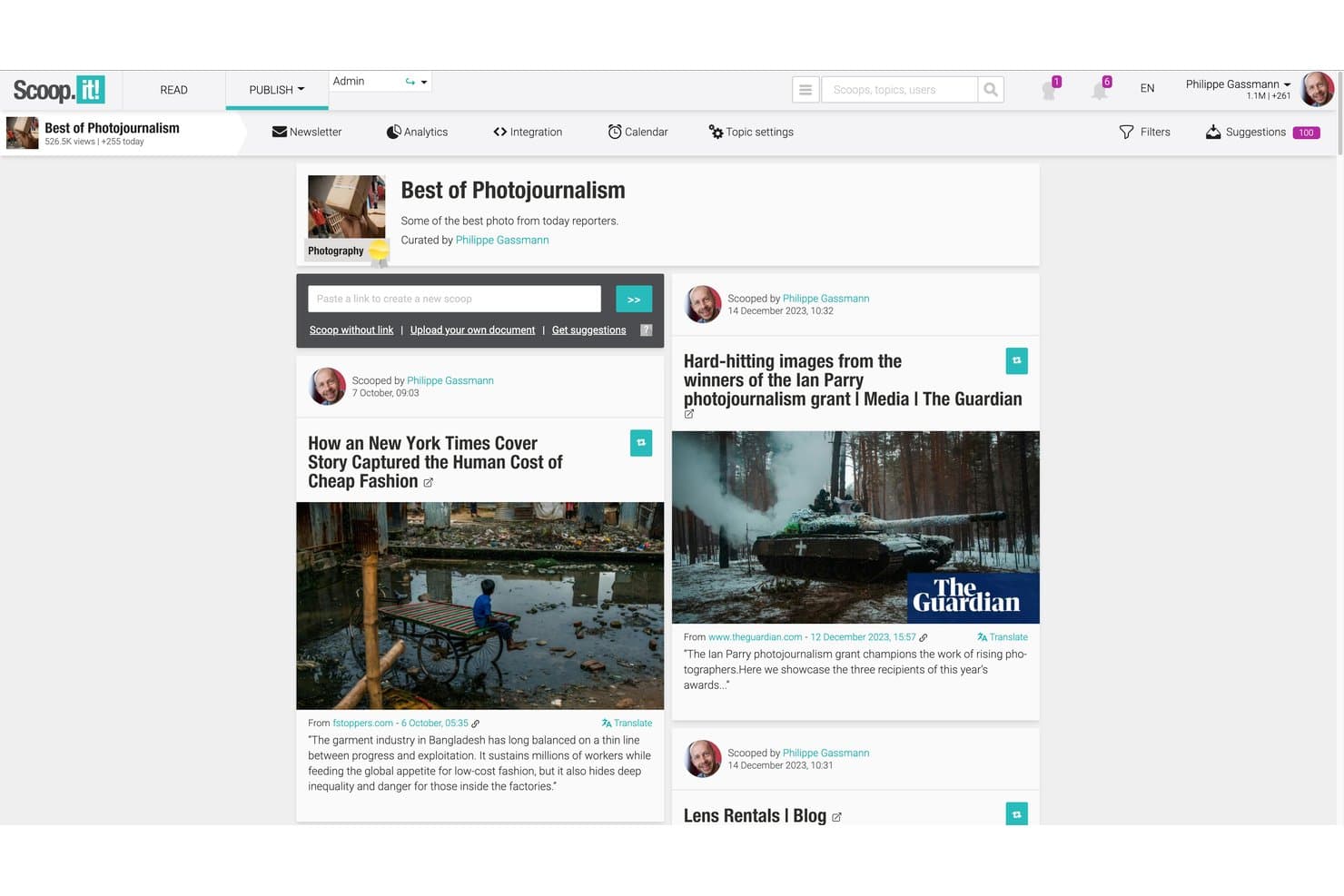
Scoop.it curates AI-sourced content into hubs, newsletters, and social posts. Scoop.it is a content curation platform that combines AI-assisted content discovery, topic-based content hubs, social publishing, and a native newsletter builder with AI-generated summaries.
Who Is Scoop.it Best For?
Scoop.it is a strong fit for content marketers and newsletter operators who want to turn curated industry content into branded email campaigns without building a separate tool stack.
Why I Picked Scoop.it
I've included Scoop.it in my top picks because its native newsletter builder does something most curation tools skip: it uses AI to auto-generate article summaries in a single click, so you can send a polished, context-rich newsletter straight from your curated feed. I also like that the platform lets you build branded topic pages that feed directly into those campaigns, keeping discovery and distribution in one place rather than stitching together separate tools.
Scoop.it Key Features
- Browser bookmarklet: Curate any web article directly from its source page in one click, without returning to the Scoop.it dashboard.
- Topic pages: Create themed, branded content hubs that can be embedded on your website, blog, or intranet as a live content library.
- Scheduled social publishing: Queue curated content for timed distribution across connected Twitter/X, LinkedIn, and Facebook accounts.
- Content performance analytics: Track audience engagement, newsletter open rates, and per-article performance stats from within the platform.
Scoop.it Integrations
Scoop.it integrates with WordPress, Microsoft Teams, Slack, Meltwater Explore, and Radarly. It also supports RSS feeds, Sitemaps, an Open API for custom integrations, and a Zapier connection.
Pros and Cons
Pros:
- Bookmarklet enables instant curation from any page
- Content hubs embed easily on any website
- AI-generated newsletter summaries save manual writing
Cons:
- Newsletter sends capped for lower-tier users
- Approval workflows require high-priced enterprise plan
Learn more about Scoop.it: Best for sharing curated insights with marketing teams
- Free trial available
- From $49/month
Visit WebsiteCustomer Rating:4.4/5
UpContent curates third-party articles for review, annotation, and distribution. UpContent is a content curation platform that discovers and organizes third-party articles from across the web, letting marketing teams review, annotate, and distribute curated content through social, email, and other channels.
Who Is UpContent Best For?
UpContent is a natural fit for marketing teams at financial services firms, where compliant, advisor-led content sharing is a core part of the sales process.
Why I Picked UpContent
I picked UpContent as one of the best because it's purpose-built for marketing teams that need to share curated content across multiple channels without losing control of the message. Its team collaboration workflow lets managers review and approve articles before they go out, which matters a lot when advisors or reps are posting independently.
I also like the Smart Seller feature, which overlays a custom CTA banner on any article you share, keeping your brand and conversion path intact even when you're linking to third-party content.
UpContent Key Features
- Topic-based content discovery: Build topic collections that continuously pull in new articles matching your chosen keywords and sources.
- Content filters: Sort discovered articles by recency, shareability, influence, or source to surface the most relevant pieces faster.
- UTM tracking: Automatically appends UTM parameters to shared article links for tracking engagement back to your curation activity.
- Gallery widget: Embed a curated content feed directly onto your website so visitors see your latest topic collections without leaving your site.
UpContent Integrations
UpContent offers native integrations with Hootsuite, HubSpot, Salesforce Marketing Cloud, Mailchimp, Buffer, Seismic LiveSocial, Proofpoint, Yext, EveryoneSocial, and SOCXO. It also supports RSS feeds from any topic collection, connects with Zapier, and has an API for custom integrations.
Pros and Cons
Pros:
- Embeds curated feeds directly on websites
- Surfaces articles by shareability and influence
- Approval workflows built for team review
Cons:
- No geographic filtering for localized content
- Topic keyword tuning requires trial and error
Learn more about UpContent: Best for enterprise-scale social embed management
- 14-day free trial
- From $110/month (billed annually)
Visit WebsiteCustomer Rating:4.7/5
Flockler aggregates, moderates, and embeds social content across digital channels. Built around social media aggregation, Flockler lets you collect, moderate, and embed content from platforms like Instagram, TikTok, and YouTube into websites, apps, and digital screens.
Who Is Flockler Best For?
Flockler is a natural fit for brands in retail, hospitality, and events that need to display live social content across multiple physical and digital touchpoints.
Why I Picked Flockler
I picked Flockler as one of the best because of how well it handles embed distribution across multiple touchpoints from a single source. My team can deploy one curated social feed to a brand website, a live event screen, and a digital kiosk without rebuilding the configuration each time.
The native digital signage output is something I rarely see in other content curation tools, and it's especially useful for campaigns that run across physical and digital spaces simultaneously.
Flockler Key Features
- Rights management: Send rights request messages directly to content creators to get permission before featuring their posts.
- Shoppable feed: Tag products directly on social posts to turn curated feeds into clickable shopping experiences.
- Custom CSS editor: Apply custom styling to any feed embed to match your brand's visual guidelines.
- Analytics dashboard: Track impressions, clicks, and engagement on embedded feeds across all active channels.
Flockler Integrations
Flockler aggregates content from Instagram, Facebook, X, YouTube, LinkedIn, TikTok, Pinterest, Bluesky, Google Reviews, RSS feeds, SoundCloud, and Flickr into unified feeds. It works with Shopify, Webflow, WordPress, and other major CMS platforms, and can embed in SharePoint and internal portals.
Pros and Cons
Pros:
- Embed feeds on digital signage screens
- Archived content persists after campaigns end
- AI-generated alt text for social images
Cons:
- Analytics reporting lacks deeper engagement data
- Limited content sources on lower plans
Learn more about Flockler: Best for annotating saved web content
- Free plan available
- From $5.99/month
Visit WebsiteCustomer Rating:4.4/5
Instapaper saves, highlights, and organizes articles for later reading. Built for saving and reading web content, Instapaper is a read-later tool with highlighting, private notes, and folder-based organization for managing articles and online research.
Who Is Instapaper Best For?
Instapaper works best for solo professionals and content creators who need a personal reading and research library they can build and reference over time.
Why I Picked Instapaper
I picked Instapaper as one of the best because its annotation layer goes deeper than most read-later tools. I highlight passages in four colors and attach private notes to specific lines in any saved article. When I revisit a piece weeks later, those color-coded marks help me pull quotes and ideas into my content without re-reading from scratch.
Instapaper Key Features
- Folder organization: Sort saved articles into custom folders to keep research topics separated and easy to browse.
- Full-text search: Search across all saved articles by keyword to locate specific content in your library.
- Speed read mode: Read saved articles word by word at a set pace to move through content quickly.
- Browser extension: Save any web page to your Instapaper library directly from your browser with one click.
Instapaper Integrations
Instapaper offers a smaller set of native integrations, including Notion, Kindle, and Rakuten Kobo. It's available on Zapier and IFTTT, and has an API for custom integrations.
Pros and Cons
Pros:
- Clean text-to-speech for saved articles
- Highlights and notes sync across devices
- Distraction-free reading strips ads and clutter
Cons:
- Notes display as separate fragmented entries
- Infrequent app updates and slow support
Learn more about Instapaper: Best for personalized news aggregation
- Free plan available
- Pricing upon request
Visit WebsiteCustomer Rating:4/5
Flipboard curates personalized news, stories, and web content by topic. Flipboard is a news aggregation and content curation app that collects articles, stories, and web content into personalized, magazine-style feeds organized by topic or interest.
Who Is Flipboard Best For?
Flipboard is a strong fit for individual professionals, journalists, and content creators who need a personal news feed organized around specific topics or industries.
Why I Picked Flipboard
Flipboard earns its spot on my shortlist because no other tool packages news aggregation around topic-level personalization quite like this. Its "For You" feed uses an algorithm that learns from what you heart, follow, and add, so the content gets sharper over time without manual adjustments.
I also like its Smart Magazines feature, which opens with broadly trending stories on a topic before narrowing to stories matched to your specific reading habits. The daily FlipDigest email pulls from the same algorithm, giving you a digest of top stories across your followed topics without logging back into the app.
Flipboard Key Features
- Custom magazines: Create ongoing, topic-specific magazines by flipping articles, videos, and podcasts from any source into a shareable collection.
- Storyboards: Package a finite set of curated links into structured, sectioned roundups with custom copy, topic tags, and shareable embeds.
- Group magazines: Invite other curators to contribute content into a shared magazine, making collaborative curation across a team possible.
- Content analytics: Track opens, impressions, click-through rate, and engagement across your magazines and storyboards from the Flipboard dashboard.
Flipboard Integrations
Flipboard lets you connect social media accounts on Twitter, LinkedIn, Tumblr, SoundCloud, YouTube, Flickr, and 500px to pull and share content within the app. It also supports Mastodon and the broader fediverse through ActivityPub, and ingests content from any RSS feed. Zapier and API support are not clearly documented.
Pros and Cons
Pros:
- Algorithm learns from interactions to personalize feeds
- Topic filtering via hashtags and category selection
- Magazine-style layout makes browsing visual content enjoyable
Cons:
- Analytics for curators are barebones
- Accessing some articles requires external logins
Learn more about Flipboard :
Other Content Curation Software
Here are some additional content curation software options that didn’t make it onto my shortlist, but are still worth checking out:
- 11ListlyBest for creating collaborative listicles
- 12DrumUpBest for scheduling curated social posts
- 13MediumBest for publishing long-form thought leadership
- 14PinterestBest for visual discovery and bookmarking
- 15ContentGemsBest for daily email content alerts
- 16InoReaderBest for custom automation with rules
- 17MyCuratorBest for WordPress content capturing
- 18Paper.liBest for automated newsletter creation
- 19eLinkBest for multi-format newsletter curation
- 20QuuuBest for human-vetted social post automation
How I Evaluate Content Curation Software
I evaluate these tools in two layers: the non-negotiable capabilities—like aggregating sources and scheduling distribution—and the differentiators that separate the strongest options from the rest.
Core Functionality (Table Stakes For This List)
When I'm selecting tools for my list, I rank each one on a scale from 0 (does not offer the functionality) to 5 (excels in this area) for each core functionality listed below. Then, I calculate the tool's total score into a percentage. Each tool needs to achieve a minimum total score of 65% to be considered for inclusion.
- Content Discovery & Aggregation: I check whether a tool can pull from RSS feeds, blogs, social platforms, and news sites into a single feed—so you're not tab-hopping across dozens of sources.
- Topic & Keyword Filtering: Strong filtering lets you zero in on SaaS-relevant subjects using saved searches, Boolean queries, or tag-based rules rather than scrolling through noise.
- AI-Powered Relevance Ranking: I evaluate how well each tool surfaces high-value content automatically—tools like Curata and Feedly, for example, both use AI to prioritize articles by relevance.
- Multi-Channel Distribution: I look for the ability to push curated content directly to social profiles, newsletters, Slack channels, or a blog without switching between separate tools.
- Content Organization & Tagging: A usable library with tags, collections, or boards matters when your team curates across multiple product lines or campaign themes and needs to retrieve assets fast.
- Team Collaboration & Approvals: I evaluate whether the tool supports shared workspaces, commenting, and approval workflows so a content lead can review curated picks before they go live.
Once I have a list of tools that meet this criteria, I consider what sets each platform apart.
Differentiating Factors (What Sets Vendors Apart)
Here's how I compare and contrast different vendors:
Standout Features
I look for built-in analytics that show how curated posts perform across channels—click-throughs, shares, and engagement trends help you double down on topics your audience responds to. AI-generated summaries are another differentiator, letting you add original commentary to a shared article without writing from scratch. I also evaluate competitor and trend monitoring, which is valuable for SaaS teams tracking rival launches or emerging industry conversations in real time.
Beyond Features
Integrations matter a lot here. I check whether a tool connects natively to the platforms SaaS teams already use—think HubSpot, Slack, Buffer, or WordPress—so curated content flows into existing workflows. Pricing structure is another key factor; I evaluate whether plans scale reasonably as teams grow or content volume increases. Copyright and attribution handling also deserves attention, since sharing third-party content without proper source linking or excerpting safeguards can create legal exposure for your brand.
How to Choose Content Curation Software
Choosing content curation software comes down to how effectively it can discover relevant content, organize sources, support publishing workflows, and distribute curated material across the channels your team uses.
| If your priority is… | Look for… |
|---|---|
| If your priority is…Finding relevant content faster | Look for…AI-assisted discovery and topic filtering |
| If your priority is…Organizing large content libraries | Look for…Tags, folders, collections, and topic hubs |
| If your priority is…Publishing curated content | Look for…Built-in publishing and scheduling tools |
| If your priority is…Sharing content across channels | Look for…Social, newsletter, and website distribution |
| If your priority is…Maintaining content quality | Look for…Source controls and relevance filters |
| If your priority is…Supporting team workflows | Look for…Collaboration, approvals, and shared libraries |
How to Vet Your Shortlist
- Test content discovery: Create a topic or keyword feed and review whether the platform consistently surfaces relevant, timely content from credible sources.
- Check filtering controls: Test whether you can refine recommendations by topic, source, language, date, or other criteria without manually sorting through unrelated results.
- Build a curated collection: Save several pieces of content and organize them into folders, topics, or collections to see how easy it is to manage a growing library.
- Test publishing workflows: Create a sample curated post or newsletter and review how the platform handles editing, attribution, scheduling, and distribution.
- Evaluate team collaboration: Add another user or test available workflow controls to confirm whether your team can review, approve, organize, and publish content without duplicating work.
What Is Content Curation Software?
Content curation software is a platform used to discover, collect, organize, and share relevant third-party or owned content around specific topics.
These tools can surface articles, reports, videos, social posts, and other resources based on keywords, interests, or selected sources. Teams can then organize that content into collections, newsletters, social posts, websites, or internal libraries.
Content curation software reduces the manual work involved in finding useful material while giving teams more control over what they share and how they distribute it.
Features
When selecting content curation software, keep an eye out for the following key features:
- Web clipping: Allows you to save entire webpages or articles directly from your browser, making it easy to build a personalized library of useful resources.
- Folder and tag organization: Lets you sort and categorize saved content using folders or custom tags, so you can quickly find, group, or prioritize items for future use.
- Full-text search: Enables you to search within all saved content—including article bodies and titles—so you can access the exact resources you need without manual scrolling.
- Annotation and highlights: Provides tools to highlight passages and add sticky notes or comments, supporting research, collaboration, and deeper content analysis.
- Offline access: Lets users read and interact with stored content even when there’s no internet connection, which is helpful for travel or spotty network conditions.
- Browser extensions: Offers add-ons for Chrome, Firefox, or other browsers, making it convenient to save content from anywhere online with a single click.
- Content sharing: Allows users to share saved articles, folders, or annotations with others via links, email, or collaborator permissions.
- Mobile app availability: Supports curation, reading, and annotating on mobile devices for content access and productivity on the go.
- Bulk import and export: Lets users migrate large collections of content into or out of the platform, streamlining onboarding or archiving as needed.
- Readability optimization: Strips away ads and clutter from saved pages, presenting clean, distraction-free reading environments for deeper focus.
Common Content Curation Software AI Features
Beyond the standard content curation software features listed above, many of these solutions are incorporating AI with features like:
- Automatic content recommendations: Uses artificial intelligence to analyze your interests and reading habits, then serves up relevant articles or sources you might not find on your own.
- AI-powered summarization: Generates concise summaries of long articles or web pages, letting you quickly review the main points without reading the entire content.
- Smart tagging and organization: Automatically adds tags, categories, or folders to new content based on its subject, saving you time and ensuring everything is neatly organized.
- Sentiment analysis: Analyzes the tone and mood of articles, helping you gauge how content might be received or quickly filter for specific perspectives.
- Duplicate detection: Identifies and removes repeated or very similar articles across your library, ensuring your curated content remains unique and free of clutter.
Benefits
Implementing content curation software provides several benefits for your team and your business. Here are a few you can look forward to:
- Centralized information management: Collect and organize articles, research, and insights from multiple sources in one searchable space.
- Streamlined knowledge sharing: Share curated content and annotations with stakeholders or teammates—improving alignment, collaboration, and collective learning.
- Faster content retrieval: Quickly find saved resources through full-text search, smart tagging, and organized folders.
- Enhanced research depth: Annotate, highlight, and comment on saved items to make insights and references easy to revisit and repurpose.
- Consistent content quality: Filter, tag, and de-duplicate entries to maintain a clean, reliable library of high-quality materials.
- Better workflow efficiency: Use browser extensions, mobile apps, and import/export tools to save and organize content without disrupting daily routines.
- Increased mobility and access: Access saved and organized content on any device—even offline—whenever research or inspiration strikes.
Costs and Pricing
Selecting content curation software requires an understanding of the various pricing models and plans available. Costs vary based on features, team size, add-ons, and more. The table below summarizes common plans, their average prices, and typical features included in content curation software solutions:
Plan Comparison Table for Content Curation Software
| Plan Type | Average Price | Common Features |
|---|---|---|
| Plan TypeFree Plan | Average Price$0 | Common FeaturesBasic web clipping, limited folders or tags, limited device sync, and core search functionality. |
| Plan TypePersonal Plan | Average Price$5-$10/user/month | Common FeaturesUnlimited saves, advanced organization, highlights and annotations, and priority support. |
| Plan TypeBusiness Plan | Average Price$10-$25/user/month | Common FeaturesTeam collaboration, admin controls, shared folders or libraries, analytics, and integration options. |
| Plan TypeEnterprise Plan | Average Price$25-$50/user/month | Common FeaturesCustom integrations, enhanced security, compliance features, user provisioning, and dedicated support. |
Content Curation Software FAQs
Here are some answers to common questions about content curation software:
Can I migrate existing bookmarks or saved articles into content curation software?
Yes, most content curation software lets you import bookmarks or saved items from browsers and other platforms. Look for import options supporting HTML or CSV files to simplify onboarding and centralize your knowledge base.
How does content curation software support team collaboration?
Content curation software supports collaboration by allowing shared folders, group annotations, and permissions for editing or viewing. This makes it easier for teams to collect, discuss, and benefit from curated resources together.
Is it possible to use content curation software offline?
Yes, many solutions offer offline access through desktop or mobile apps. You can read, annotate, and organize saved content without an internet connection, which is helpful for remote work or travel.
What security measures should I expect in content curation tools?
Expect core safeguards like encrypted data storage, user authentication, and admin tools to restrict access. If you manage sensitive information, check for compliance certifications or advanced security settings before selecting a platform.
Do content curation tools integrate with other productivity or research apps?
Yes, many tools connect natively or via APIs to platforms like Notion, Slack, or project management systems. This helps streamline workflows, centralize research, and reduce manual steps across your tools.