

Content creation software gives your team the tools to write, design, publish, and manage content across different formats. If you’re searching for the best content creation software, you’re probably dealing with scattered drafts, off-brand designs, slow approvals, or too many tools for different content types.
The right platform gives your team a clearer way to produce content without losing control over quality, branding, deadlines, or distribution. In this list, I’ll break down the top options available, highlight where each tool fits best, and make it easier to choose software that matches your content workflow in 2026.
Why Trust Our Software Recommendations
6,700+
Reviews
20
Industry experts
16+
Evaluation factors
14
Years
Our team has been testing and reviewing software since 2012. As publishers and media operators ourselves, we know how difficult—and important—it is to choose the right software.
For this guide, we evaluated tools using hands-on testing and independent research, scoring tools using our selection criteria.
Our reviews reflect our human editorial judgment, not a sales pitch.
Content Creation Software Comparison Table
The table below compares pricing, trial access, and content use cases for my top content creation software selections.
| Tool | Best For | Trial Info | Price | ||
|---|---|---|---|---|---|
| 1 | Best for solo founders | 14-day free trial | From $29/month | Website | |
| 2 | Best for optimizing LinkedIn post performance | Free demo available | From £5/user/month (billed annually) | Website | |
| 3 | Best for SEO-led content planning | 14-day free trial | From $139/month | Website | |
| 4 | Best for AI social content planning | 7-day free trial available | From $19/month (billed annually) | Website | |
| 5 | Best for digital magazines and catalogs | Free demo available | From $50/month/account | Website | |
| 6 | Best for enterprise AI content governance | Free trial + free demo available | Pricing upon request | Website | |
| 7 | Best for professional creative production | 14-day free trial | From $37.99/month (billed annually) | Website | |
| 8 | Best for locked brand templates | Free plan + free demo available | From $10/user/month (billed annually) | Website | |
| 9 | Best for interactive sales content | Free demo available | From $15/user/month (billed annually) | Website | |
| 10 | Best for branded microsites | Free demo available | Pricing upon request | Website |


Best Content Creation Software Reviews
Below are my detailed summaries of the best content creation software that made it onto my shortlist. These reviews cover each tool’s use case, key features, integrations, and trade-offs.

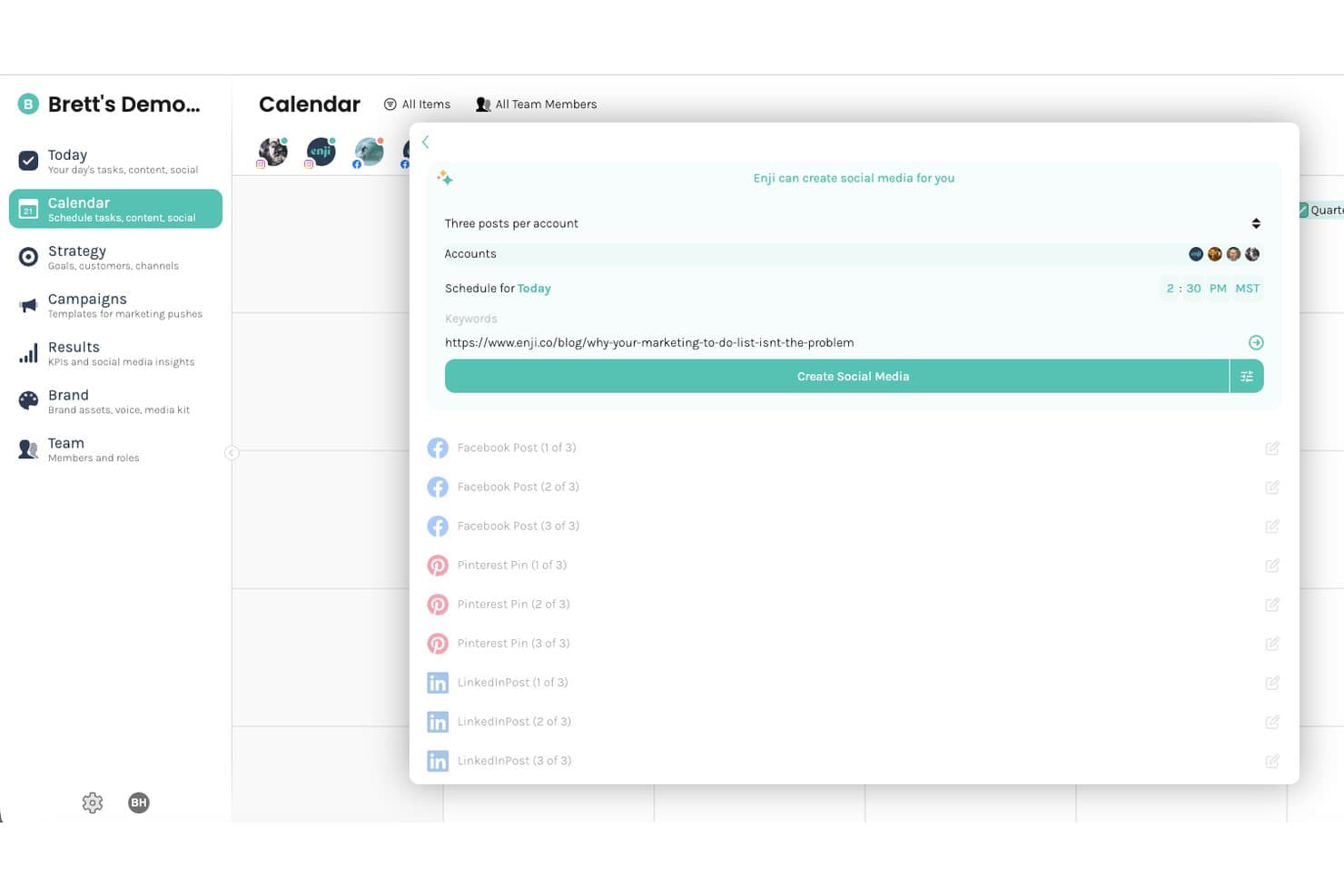
Enji offers an AI-powered social media creation tool that generates multiple posts across Facebook, Pinterest, and LinkedIn from a single URL input. Enji is a small business marketing platform that combines AI-powered content creation, social media scheduling, a marketing strategy builder, and a KPI dashboard in one tool.
Who Is Enji Best For?
Enji is a strong fit for solopreneurs and very small business owners who handle all of their own marketing without a dedicated team.
Why I Picked Enji
I picked Enji as one of the best because it's the only tool on this list that pairs AI content creation with a full marketing execution layer built for one person. I like how the AI copywriter learns your brand voice and applies it consistently across blog posts, captions, and newsletters, so every output sounds like you wrote it. The content repurposing tool is where it really earns its place: one blog post becomes a month of social content without starting from scratch each time.
Enji Key Features
- Marketing calendar with task management: Map out campaigns and manage tasks on a unified drag-and-drop calendar view.
- KPI and analytics dashboard: Monitor marketing campaign performance and social engagement data in one place.
- Brand management workspace: Store brand visuals, preferences, and messaging guidelines for consistent outputs.
- Social media scheduling: Connect accounts to draft and schedule posts directly to multiple social platforms.
Enji Integrations
Enji offers native integrations with Instagram, Facebook (Meta), LinkedIn, TikTok, Pinterest, Threads, YouTube, Canva, and Google Analytics 4.
Pros and Cons
Pros:
- Strategy and execution live in one place
- Content repurposing across social formats built in
- AI copywriter adapts to your brand voice
Cons:
- Not built for multi-user team collaboration
- Limited depth for long-form SEO content
Learn more about Enji: Best for optimizing LinkedIn post performance
- Free demo available
- From £5/user/month (billed annually)
Visit WebsiteCustomer Rating:5/5
Vulse shows a post creation dashboard with a content score evaluation. Vulse is a LinkedIn employee advocacy platform that combines AI post generation, content scoring, scheduling, and team analytics for B2B teams that want to manage and measure LinkedIn content across personal profiles and company pages.
Who Is Vulse Best For?
Vulse works well for B2B marketing teams and sales professionals who manage LinkedIn content at scale across multiple team members or company pages.
Why I Picked Vulse
I picked Vulse as one of the best because of how directly its content scoring system connects to post performance. Every post you draft gets scored before it goes live, which means I can see immediately whether a piece of content has what it takes to perform on LinkedIn rather than guessing after the fact. Pair that with its AI-powered post generator, which learns individual tone of voice and surfaces topic suggestions tailored to your audience, and your team is consistently producing content that's built to drive engagement.
Vulse Key Features
- Content calendar: Schedule and manage LinkedIn posts for individuals and company pages from a single shared calendar view.
- Live analytics dashboard: Track post-level performance data, including impressions, engagement, and follower growth, in real time.
- Article summariser: Generate a LinkedIn post from any article by pasting its URL into Vulse.
- Team leaderboard: See which team members are most active and engaging to strengthen your LinkedIn presence.
Vulse Integrations
Vulse offers native integrations with LinkedIn. An API is available for custom integrations.
Pros and Cons
Pros:
- Scores post quality with optimization meters
- Includes an employee advocacy leaderboard
- AI tone matching tailored to each user
Cons:
- Lacks publishing tools for other B2B networks
- Offers few third-party integrations
Learn more about Vulse:

Semrush supports SEO research, content planning, keyword analysis, and brand visibility tracking. Semrush is a digital visibility platform for SEO, PPC, social, content marketing, and AI search visibility. Its platform covers keyword research, competitive analysis, site audits, backlink tracking, and visibility insights, making it useful for teams that create content based on search demand and competitor data.
Who Is Semrush Best For?
Semrush is a strong fit for content marketers, SEO teams, and agencies that need content creation tied to keyword research, rankings, competitor analysis, and search visibility.
Why I Picked Semrush
I picked Semrush because it is useful before the writing starts. It gives content teams the research layer they need to choose topics, understand search intent, identify keyword gaps, and prioritize content based on demand.
I especially like it for teams that do not want content creation to be based only on brainstorming. Semrush gives writers and strategists a clearer foundation for briefs, topic clusters, and optimization work.
Semrush Key Features
- Keyword research: Find keyword ideas, search volume, competition data, and related search terms.
- Competitive analysis: Review competitor visibility, traffic estimates, and ranking opportunities.
- Content marketing tools: Plan and optimize content using SEO and audience insights.
- Site audit: Identify technical SEO issues that may affect content performance.
Semrush Integrations
Semrush integrates with Google Analytics, Google Search Console, Google Ads, Google Business Profile, Looker Studio, Trello, WordPress, and Google Docs.
Pros and Cons
Pros:
- Useful for briefs, optimization, and content gap analysis
- Good fit for SEO-led content planning
- Strong keyword and competitor research tools
Cons:
- Learning curve may be steep for non-SEO users
- Pricing can be high for small teams
Learn more about Semrush: Best for AI social content planning
- 7-day free trial available
- From $19/month (billed annually)
Visit WebsiteCustomer Rating:4.6/5
ContentStudio plans, creates, schedules, publishes, and analyzes social media content. ContentStudio is a social media management and content marketing platform backed by AI. It gives teams a shared workspace to plan content calendars, schedule posts, manage approvals, publish across social channels, and track performance from one dashboard.
Who Is ContentStudio Best For?
ContentStudio is a good fit for social media teams, agencies, and content marketers that manage multiple channels and need planning, publishing, approvals, and reporting in one place.
Why I Picked ContentStudio
I picked ContentStudio because it brings content planning and social publishing into the same workflow. Teams can plan posts in calendar, list, feed, or grid views, then move the content into scheduling, approval, and reporting without shifting between separate tools.
I also like that its AI features support social content creation and performance analysis, which makes it useful for teams that need to produce posts consistently across different channels.
ContentStudio Key Features
- Unified content calendar: Plan and review content in calendar, list, feed, and grid views.
- AI content creation: Generate social captions and content ideas using built-in AI tools.
- Approval workflows: Share calendars with team members, clients, or approvers for review.
- Analytics and reporting: Track campaign, label, and competitor performance across social channels.
ContentStudio Integrations
ContentStudio integrates with Facebook, Instagram, LinkedIn, X, Pinterest, YouTube, TikTok, Google Business Profile, WordPress, Medium, Tumblr, Webflow, Shopify, Canva, Bitly, Feedly, Pocket, Replug, Google Drive, Dropbox, Box, and OneDrive.
Pros and Cons
Pros:
- Supports approvals, publishing, and reporting in one platform
- AI tools for content creation and performance insights
- Multiple calendar views for planning social content
Cons:
- Advanced collaboration and reporting may require higher-tier plans
- No permanent free plan listed
Learn more about ContentStudio: Best for digital magazines and catalogs
- Free demo available
- From $50/month/account
Visit WebsiteCustomer Rating:4.5/5
Joomag creates digital magazines, catalogs, brochures, reports, and content experiences. Joomag is a content experience platform for creating and distributing high-design digital publications such as magazines, catalogs, brochures, proposals, and reports. It also supports personalized and interactive content, with tools for AI, content automation, analytics, forms, and reader data capture.
Who Is Joomag Best For?
Joomag is a strong fit for teams that create polished digital publications and need tools for distribution, reader engagement, and performance tracking.
Why I Picked Joomag
I picked Joomag because it focuses on publication-style content rather than general project management. It works well when the output needs to look like a magazine, catalog, annual report, brochure, or interactive document.
I also like that its platform includes analytics and reader data capture, which makes it useful for teams that want to understand how audiences interact with their published content.
Joomag Key Features
- Digital publication editor: Create magazines, catalogs, brochures, reports, and other designed content formats.
- Interactive publications: Add interactive elements to make content more engaging than static PDFs.
- Reader data capture: Collect audience data from publication interactions and embedded forms.
- Analytics: Track publication performance and reader behavior after distribution.
Joomag Integrations
Joomag integrates with Salesforce, HubSpot, Mailchimp, Google Analytics, Dropbox, Box, and Constant Contact.
Pros and Cons
Pros:
- Supports interactive and personalized content
- Built-in analytics for publication performance
- Strong fit for digital magazines and catalogs
Cons:
- Less suited to simple blog or social post workflows
- Pricing is not clearly listed on the main site
Learn more about Joomag: Best for enterprise AI content governance
- Free trial + free demo available
- Pricing upon request
Visit WebsiteCustomer Rating:4.4/5
Writer creates governed AI content, brand-compliant copy, and enterprise-ready workflows. Writer is an enterprise AI platform that supports content generation, automation, brand governance, and compliant AI workflows. Its platform includes WRITER Agent, AI Studio, Graph RAG, Palmyra LLMs, Knowledge Graph, and brand controls for teams that need AI-generated work to follow internal standards.
Who Is Writer Best For?
Writer is a strong fit for enterprise marketing, content, legal, and operations teams that need AI content creation with brand, compliance, and knowledge controls.
Why I Picked Writer
I picked Writer because it focuses on governed AI content rather than simple AI writing. That matters for larger teams where content needs to follow brand rules, approved terminology, internal knowledge, legal standards, and role-specific workflows.
I especially like that Writer gives teams more control over how AI produces content. Instead of letting every user generate copy differently, teams can use shared knowledge, playbooks, and brand settings to keep output consistent.
Writer Key Features
- WRITER Agent: Use one interface for chat, automation, and AI-assisted work.
- Playbooks: Create reusable instructions for repeatable content and workflow tasks.
- Knowledge Graph: Ground AI output in approved company information.
- Brand and style controls: Guide AI-generated content using shared standards for voice, terminology, and compliance.
Writer Integrations
Writer integrates with Google Drive through its Knowledge Graph and offers basic connectors in its Starter plan. Its platform also supports enterprise AI workflows through AI Studio, WRITER Agent, Graph RAG, and custom enterprise setup options.
Pros and Cons
Pros:
- 14-day free trial available
- Supports brand, compliance, and knowledge controls
- Strong fit for governed AI content creation
Cons:
- May be too advanced for small teams needing simple writing support
- Pricing is not fully public for enterprise needs
Learn more about Writer: Best for professional creative production
- 14-day free trial
- From $37.99/month (billed annually)
Visit WebsiteCustomer Rating:4.5/5
Adobe Creative Cloud creates graphics, videos, layouts, photos, audio, and branded creative assets. Adobe Creative Cloud is a creative production suite with 20+ apps for design, photography, video editing, illustration, animation, and document creation, including Photoshop, Illustrator, Premiere Pro, InDesign, Acrobat Pro, and Adobe Firefly.
Who Is Adobe Creative Cloud Best For?
Adobe Creative Cloud is a strong fit for creative, design, and marketing teams that need professional-grade tools for producing high-quality visual, video, print, and digital content.
Why I Picked Adobe Creative Cloud
I picked Adobe Creative Cloud because it covers nearly every major creative format a content team might produce. Instead of relying on separate apps for photo editing, page layout, video editing, design, and generative image work, teams can use one creative suite across many production needs.
I especially like its fit for teams with experienced designers, editors, or brand specialists who need deeper control than lightweight content creation platforms usually offer.
Adobe Creative Cloud Key Features
- Photoshop: Edit, retouch, and create images for campaigns, web pages, ads, and social content.
- Illustrator: Create logos, icons, vector graphics, and brand illustrations.
- Premiere Pro: Edit video content for campaigns, social channels, and long-form creative projects.
- Adobe Firefly: Generate and edit creative assets using Adobe’s generative AI tools.
Adobe Creative Cloud Integrations
Adobe Creative Cloud integrates with Slack, Microsoft Teams, and other third-party apps through Adobe Exchange.
Pros and Cons
Pros:
- Includes industry-standard apps used by design teams
- Strong fit for professional creative production
- Covers design, video, photo, layout, and AI content creation
Cons:
- Steeper learning curve than simpler creation tools
- A full suite may be more than smaller teams need
Learn more about Adobe Creative Cloud: Best for locked brand templates
- Free plan + free demo available
- From $10/user/month (billed annually)

Lucidpress protects brand assets with locked templates and customization. LucidPress, now Marq is a brand enablement and design platform that gives teams access to branded templates for assets like brochures, flyers, social posts, newsletters, and one-sheets. Its template-locking tools allow brand teams to protect logos, fonts, and colors while still giving other teams room to customize approved materials.
Who Is LucidPress Best For?
LucidPress is a good fit for marketing, sales, and brand teams that need non-designers to create approved content without breaking brand rules.
Why I Picked LucidPress
I picked LucidPress because it solves a common content creation issue: too many teams need marketing assets, but not every asset should go through a designer. I like that Marq allows creative teams to lock specific brand elements inside templates, so local teams, sales teams, or field marketers can edit approved sections without changing the full design.
That makes it useful for teams producing repeated content formats like flyers, brochures, event materials, social graphics, or sales sheets.
LucidPress Key Features
- Lockable templates: Protect brand elements like logos, colors, fonts, and layouts while still allowing controlled edits.
- Template library: Start from ready-made templates for brochures, social posts, flyers, newsletters, and other branded content.
- Drag-and-drop editor: Create and adjust layouts without advanced design knowledge.
- Brand asset control: Store approved fonts, colors, images, and logos so teams work from the same visual system.
LucidPress Integrations
LucidPress integrates with Flipsnack, MediaValet, Bynder, HubSpot, Asana, and PhotoShelter.
Pros and Cons
Pros:
- Brand consistency controls
- Good fit for repeatable marketing collateral
- Strong template-locking for brand control
Cons:
- More focused on branded design than long-form content workflows
- LucidPress branding has changed to Marq, which may cause search confusion
Learn more about Marq (formerly LucidPress): Best for interactive sales content
- Free demo available
- From $15/user/month (billed annually)

Cleverstory creates interactive pages, content experiences, and sales enablement assets. Cleverstory by Paperflite is an interactive content creation platform that allows marketers to create interactive content experiences without writing code. Its website positions the product for teams that want to move beyond static documents and understand content consumption in more detail.
Who Is Cleverstory Best For?
Cleverstory is a good fit for marketing and sales teams that need interactive content experiences for campaigns, product stories, lead generation, and sales conversations.
Why I Picked Cleverstory
I picked Cleverstory because it turns content into interactive experiences instead of simple static assets. That makes it useful for teams creating pitch materials, sales pages, product explainers, or gated content that needs to feel more engaging than a standard PDF.
I also like that Cleverstory connects content creation with audience behavior, giving teams a clearer view of how people interact with the content after it is shared.
Cleverstory Key Features
- No-code interactive builder: Create interactive content pages without relying on developers.
- Content experience tracking: See how audiences interact with shared content.
- Drag-and-drop creation: Build interactive pages using a visual content editor.
- Sales content experiences: Create content pages for buyer education, campaigns, and sales follow-up.
Cleverstory Integrations
Cleverstory integrates with HubSpot, Pardot, Marketo, and Microsoft Azure SSO.
Pros and Cons
Pros:
- Tracks how audiences engage with content
- No-code creation reduces developer dependency
- Strong fit for interactive sales and marketing content
Cons:
- Less suited to basic writing or design tasks
- Pricing is not publicly listed
Learn more about Cleverstory:

Zoomforth creates branded microsites, sales proposals, customer portals, and internal content hubs. Zoomforth is an enterprise microsite builder and content platform that allows teams to create branded, media-rich microsites without relying on development resources. It supports use cases like sales proposals, marketing campaigns, customer portals, and internal communications. Its site also references enterprise security features such as SOC 2, GDPR readiness, and SSO.
Who Is Zoomforth Best For?
Zoomforth is a strong fit for enterprise marketing, sales, and communications teams that need branded microsites for specific campaigns, clients, accounts, or internal audiences.
Why I Picked Zoomforth
I picked Zoomforth because it focuses on a specific content format that many teams struggle to manage: microsites. Instead of building one-off pages through web development, teams can create branded content destinations for proposals, campaigns, customer education, or internal updates.
I also like that Zoomforth includes tracking, which matters when teams need to see how viewers engage with content after it is shared.
Zoomforth Key Features
- Microsite builder: Create branded microsites for campaigns, proposals, portals, and internal communications.
- Media-rich content: Add visual and multimedia content to make pages more engaging.
- Engagement tracking: Track how audiences interact with microsite content.
- Enterprise controls: Use security and access features suited to enterprise content teams.
Zoomforth Integrations
Zoomforth integrates with Adobe Analytics, Azure AD, HubSpot, Google Analytics, LinkedIn, Microsoft Teams, Microsoft Word, Microsoft Excel, Salesforce, Zapier, and custom domains.
Pros and Cons
Pros:
- Includes enterprise security positioning
- Useful for sales, marketing, and internal content hubs
- Strong fit for branded microsites
Cons:
- Annual contract requirement may be too much for smaller teams
- Pricing is not publicly listed
Learn more about Zoomforth:
Other Content Creation Software
Here are some additional content creation software options that didn’t make it onto my shortlist, but are still worth checking out:
- 11GatherContentBest for structured editorial workflows
- 12Ceros StudioBest for no-code interactive content
- 13GrammarlyBest for AI writing corrections
- 14PixlrBest for browser-based image editing
- 15CanvaBest for quick visual content creation
- 16ion interactive Best for enterprise interactive content
- 17involve.meBest for lead-generation content funnels
- 18ZencastrBest for remote podcast recording
- 19Hemingway EditorBest for improving readability
- 20VidlabBest for mobile video editing
- 21Izitext.ioBest for fast transcription editing
- 22ApesterBest for interactive audience polls
- 23AudacityBest for open-source audio editing
- 24GarageBandBest for Apple-based audio production
How I Evaluate Content Creation Software
I evaluate these tools in two layers: the baseline capabilities a SaaS marketer needs to ship blog posts and product pages, and the differentiators that make one tool the right fit over another.
Core Functionality (Table Stakes For This List)
When I'm selecting tools for my list, I rank each one on a scale from 0 (does not offer the functionality) to 5 (excels in this area) for each core functionality listed below. Then, I calculate the tool's total score into a percentage. Each tool needs to achieve a minimum total score of 65% to be considered for inclusion.
- Multi-Format Content Creation: I check whether a tool handles text, images, video, and graphics—or just one format. SaaS teams need to ship blog posts and ad creatives from one place.
- AI-Assisted Generation: From first drafts to social copy, I look for AI that goes beyond basic templates and actually accelerates how fast your team produces assets.
- Brand Consistency Controls: Brand kits with locked fonts and colors are table stakes. I evaluate whether a tool lets you enforce tone and voice across every asset your team creates.
- Collaboration & Review Workflows: Real-time editing, comments, and approval chains matter when product marketing and demand gen are working on the same launch page.
- SaaS Marketing Integrations: I look for native connections to tools like HubSpot, WordPress, and Webflow—plus API or Zapier access for custom workflows your team relies on.
- Content Export & Publishing: Your team should be able to export in multiple formats or publish directly to a CMS, social channel, or email platform without extra steps.
Once I have a list of tools that meet this criteria, I consider what sets each platform apart.
Differentiating Factors (What Sets Vendors Apart)
Here's how I compare and contrast different vendors:
Standout Features
Built-in SEO scoring is a big differentiator. I look for tools that surface keyword opportunities and on-page recommendations inside the editor, so your team doesn't toggle between platforms. Content repurposing automation also matters. When a tool can break a webinar into social clips, email snippets, and blog summaries, it saves hours of manual reformatting. I also evaluate whether a platform lets you train its AI on your product docs and messaging frameworks to keep generated output accurate and on-brand.
Beyond Features
Pricing and time-to-value are top of mind. I look for transparent pricing and a free trial or freemium tier, because SaaS marketers need to validate a tool's fit before committing budget. AI data policies also deserve close attention—I check whether a vendor trains its models on your inputs, which matters when you're feeding in unreleased product messaging. Finally, I consider how well a platform scales from a two-person marketing team to a multi-brand org with SSO and role-based permissions.
How to Choose Content Creation Software
It’s easy to get distracted by long feature lists, especially because content creation software can cover writing, design, video, audio, social media, and interactive content. To stay focused, use these factors when comparing your options:
| Factor | What to Consider |
|---|---|
| FactorScalability | What to ConsiderWill the tool still fit as your content output grows? Check user limits, asset storage, template controls, and whether larger teams require a higher-tier plan. |
| FactorContent formats | What to ConsiderDoes the platform support the type of content your team creates most often, such as blogs, social posts, videos, branded documents, microsites, podcasts, or interactive assets? |
| FactorCustomizability | What to ConsiderCan you adjust templates, workflows, fields, brand rules, approval stages, and export settings to match how your team works? |
| FactorEase of use | What to ConsiderIs the editor simple enough for daily users? Test how quickly someone can create, review, and export content without heavy training. |
| FactorImplementation and onboarding | What to ConsiderHow difficult is it to set up templates, migrate brand assets, invite team members, and build repeatable workflows? |
| FactorCost | What to ConsiderReview monthly fees, user-based pricing, asset storage limits, AI usage limits, and add-ons for publishing, analytics, or advanced collaboration. |
| FactorSecurity safeguards | What to ConsiderDoes the platform support permissions, SSO, MFA, audit logs, and content access controls where needed? This matters when managing client files, brand assets, or unpublished campaigns. |
| FactorSupport availability | What to ConsiderCan your team get timely assistance during setup or production issues? Check support channels, response times, onboarding services, and help center depth. |
What Are Content Creation Software?
Content creation software are digital tools that help teams create, edit, manage, and publish content across formats like written copy, graphics, videos, audio, social posts, digital publications, and interactive experiences.
These platforms typically support templates, editing tools, collaboration features, brand controls, approval workflows, and publishing or export options. Some tools focus on one format, such as audio editing or image design, while others support broader content operations across planning, production, review, and distribution.
Features
When selecting content creation software, keep an eye out for the following key features:
- Content editor: Allows users to create and edit written, visual, audio, video, or interactive content inside the platform.
- Templates: Provides pre-built layouts, briefs, designs, or content structures that speed up repeatable production work.
- Brand controls: Keeps logos, colors, fonts, tone, and approved messaging consistent across content assets.
- Collaboration tools: Supports comments, shared editing, task assignments, and team feedback during the creation process.
- Approval workflows: Routes content through review stages so editors, managers, legal teams, or clients can approve work before publishing.
- Asset library: Stores images, videos, documents, templates, and other reusable creative files in one place.
- AI writing or design tools: Generates drafts, captions, outlines, visuals, or content suggestions based on prompts or existing material.
- Publishing tools: Sends finished content to websites, social channels, CMS platforms, email tools, or other distribution channels.
- Analytics: Tracks content performance, engagement, views, clicks, or audience behavior after publication.
- Permission controls: Limits who can view, edit, approve, publish, or manage specific content assets and workflows.
Common Content Creation Software AI Features
Beyond the standard content creation software features listed above, many platforms are adding AI with features like:
- AI writing assistance: Generates outlines, blog sections, captions, emails, product descriptions, or campaign copy from prompts.
- Content repurposing: Turns one asset into multiple formats, such as converting a blog post into social captions, email copy, or video scripts.
- Brand voice guidance: Checks content against approved tone, terminology, and style rules before publication.
- Image generation: Creates visuals, backgrounds, or campaign assets from text prompts.
- Caption and hashtag suggestions: Recommends social captions and hashtags based on campaign topics, audience data, or platform trends.
- SEO recommendations: Suggests keywords, headings, content gaps, and readability improvements for search-focused content.
- Content performance insights: Uses engagement data to recommend topics, formats, publishing times, or optimization opportunities.
- Automated transcription: Converts audio or video files into editable text for podcasts, interviews, webinars, and video content.
- Personalization: Adjusts content variations for different audience segments, industries, regions, or buyer stages.
Benefits
Implementing content creation software provides several benefits for your team. Here are a few you can look forward to:
- Faster content production: Gives teams templates, editors, AI tools, and shared workspaces that reduce the time spent starting from scratch.
- Better brand consistency: Keeps logos, colors, fonts, templates, and messaging guidelines in one place so content stays aligned across teams.
- Improved collaboration: Gives writers, designers, editors, marketers, and reviewers a shared place to comment, revise, and approve work.
- More content format coverage: Supports different formats such as blogs, videos, social posts, graphics, podcasts, digital publications, and interactive experiences.
- Clearer review processes: Routes content through approval stages so stakeholders can check drafts, designs, or assets before they go live.
- Easier content reuse: Stores templates, assets, previous campaigns, and approved copy so teams can repurpose existing work instead of recreating everything.
- Stronger content performance tracking: Uses analytics and engagement data to show which assets are getting views, clicks, conversions, or audience interaction.
- More controlled AI use: Gives teams AI writing, design, and repurposing tools while still supporting brand voice rules, permissions, and review steps.
Costs and Pricing
Selecting content creation software requires an understanding of the different pricing models available. Costs vary based on content format, user seats, AI usage, storage, publishing features, brand controls, analytics, and enterprise security needs.
The table below summarizes common plans, their average prices, and typical features included in content creation software solutions:
Plan Comparison Table for Content Creation Software
| Plan Type | Average Price | Common Features |
|---|---|---|
| Plan TypeFree Plan | Average Price$0 | Common FeaturesBasic editing tools, limited templates, simple exports, restricted storage, and basic collaboration features. |
| Plan TypePersonal Plan | Average Price$5-$20/user/month | Common FeaturesMore templates, standard exports, light AI assistance, personal asset storage, and basic publishing options. |
| Plan TypeBusiness Plan | Average Price$20-$100/user/month | Common FeaturesTeam workspaces, approval workflows, brand controls, shared asset libraries, analytics, publishing tools, and expanded storage. |
| Plan TypeEnterprise Plan | Average PriceCustom pricing | Common FeaturesSSO, audit logs, advanced permissions, custom integrations, governed AI, dedicated support, and stronger security controls. |
Content Creation Software FAQs
Here are frequently asked questions about content creation software:
Can content creation software support multiple content formats?
Yes, many tools support several formats, including blog posts, graphics, videos, social posts, audio files, digital publications, and interactive content. Some platforms focus on one format, while others cover broader production workflows.
Can content creation software improve brand consistency?
Yes, many platforms include brand kits, locked templates, approved asset libraries, style guides, and permission controls to keep content aligned across teams and channels.
Does content creation software support team collaboration?
Yes, most content creation tools include comments, shared editing, task assignments, review stages, and approval workflows so writers, designers, editors, and stakeholders can work in the same space.
Can content creation software include AI features?
Yes, many platforms now offer AI writing assistance, image generation, caption suggestions, content repurposing, transcription, SEO recommendations, and brand voice checks.
Does content creation software replace designers or writers?
No. It can speed up production and reduce repetitive work, but strong content still needs planning, editing, creative judgment, and quality review from the team.