

Content calendar software helps your team organize, schedule, and track content production across marketing, social, and editorial channels. If you’re hunting for the best content calendar software, you’re probably juggling tight deadlines, scattered files, and the pressure to align teams all year.
The right platform keeps everyone on the same page so you can plan confidently and never lose sight of what’s next. In this list, I’ll break down the top options available, highlight where each tool shines, and help you pick a solution that fits your unique workflow in 2026.
Why Trust Our Software Recommendations
6,700+
Reviews
20
Industry experts
16+
Evaluation factors
14
Years
Our team has been testing and reviewing software since 2012. As publishers and media operators ourselves, we know how difficult—and important—it is to choose the right software.
For this guide, we evaluated tools using hands-on testing and independent research, scoring tools using our selection criteria.
Our reviews reflect our human editorial judgment, not a sales pitch.
Content Calendar Software Comparison Table
The table below compares pricing details for my top content calendar software selections.
| Tool | Best For | Trial Info | Price | ||
|---|---|---|---|---|---|
| 1 | Best for solo creators | 14-day free trial | From $29/month | Website | |
| 2 | Best for scalable, AI-powered data collaboration | Free plan available; 14-day free trial | From $20/user/month (billed annually) | Website | |
| 3 | Best for AI-assisted social media content scheduling | Free trial available | From $49/month (billed annually) | Website | |
| 4 | Best for campaign and editorial planning at scale | Free plan available | From $10.99/user/month (billed annually) | Website | |
| 5 | Best for managing cross-channel brand experiences | 30-day free trial | Pricing upon request | Website | |
| 6 | Best for centralizing all project work in one hub | Free plan available | From $10/user/month | Website | |
| 7 | Best for agencies managing multi-channel media plans | Free demo available | Pricing upon request | Website | |
| 8 | Best for structured content approval workflows | Free demo available | Pricing upon request | Website | |
| 9 | Best for integrated marketing campaign planning | 7-day free trial | From $117.33/month (billed annually) | Website | |
| 10 | Best for teams needing advanced automation | 14-day free trial | From $10/user/month (billed annually) | Website |


Best Content Calendar Software Reviews
Below are my detailed summaries of the best content calendar software that made it onto my shortlist. My reviews offer a detailed look at the features, best use cases, and integrations of each platform to help you find the best one for you.

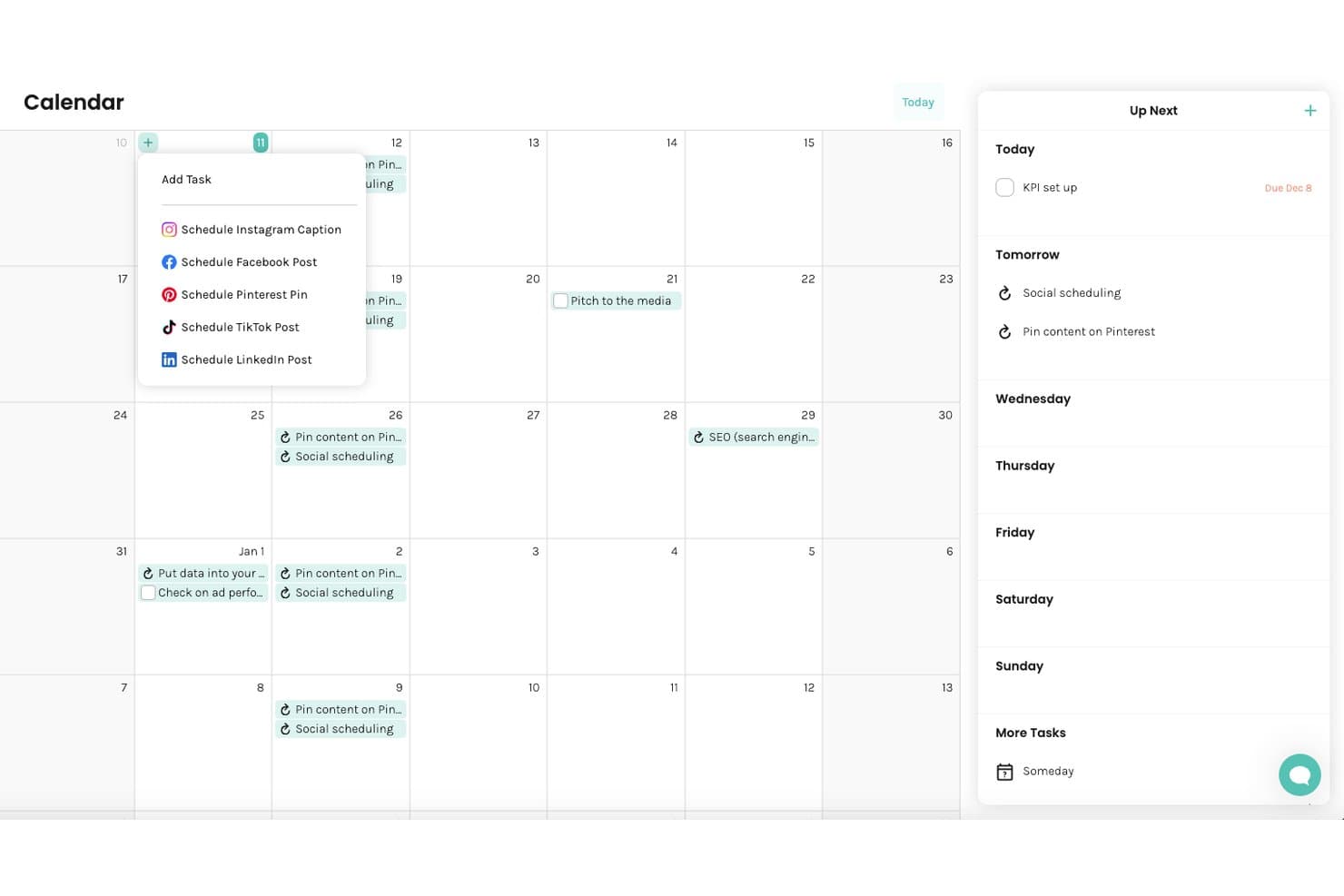
Enji offers a calendar view with social media post scheduling options, recurring tasks, and a sidebar showing daily and weekly task breakdowns. Enji is a small business marketing platform that combines a guided strategy generator, marketing calendar, AI copywriter, and social media scheduler into a single tool.
Who Is Enji Best For?
Enji is built for solopreneurs and small business owners who handle their own marketing without a dedicated team or marketing background.
Why I Picked Enji
I picked Enji as one of the best because its Marketing Strategy Generator does something most content calendar tools skip entirely. Answer a short questionnaire, and Enji auto-builds a personalized marketing plan with tasks that land directly on your calendar. I also like the pre-built two-week campaign templates, which come with mapped tasks, timing, and metrics so a solopreneur can launch a campaign without building the strategy from scratch.
Enji Key Features
- AI copywriter: Generates social media captions, blog drafts, newsletters, and more in your brand voice.
- Content repurposing tool: Quickly turns one piece of content into multiple new assets for different channels.
- KPI dashboard: Displays analytics from social channels and Google Analytics 4 within the platform.
- Brand management storage: Stores and organizes your brand voice, visuals, and key brand details for easy reference.
Enji Integrations
Enji offers native integrations with Instagram, Facebook, LinkedIn, TikTok, YouTube, Pinterest, Threads, Google Analytics 4, and Canva.
Pros and Cons
Pros:
- AI copywriter covers blogs, social, and newsletters
- Pre-built templates include mapped content tasks
- Auto-populates your marketing calendar
Cons:
- Reporting limited compared to dedicated tools
- Not designed for multi-person team workflows
Learn more about Enji: Best for scalable, AI-powered data collaboration
- Free plan available; 14-day free trial
- From $20/user/month (billed annually)
Visit WebsiteCustomer Rating:4.6/5
Airtable organizes content workflows, custom views, databases, and AI agents. Airtable is a no-code database and app-building platform where teams can plan, organize, and manage content workflows using customizable views like calendar, grid, Kanban, and Gantt, with AI agents built directly into the data layer.
Who Is Airtable Best For?
It's a strong fit for mid-size to enterprise content and marketing teams that manage high volumes of content across multiple contributors and need structured, customizable workflows.
Why I Picked Airtable
Airtable earns its spot on my shortlist because no other content calendar tool handles data at this scale. Field Agents let you deploy AI across thousands of records at once, so your team can analyze content performance, categorize assets, or generate briefs across an entire content library without manual effort.
HyperDB supports up to 100 million records per table, which means the platform doesn't break as your content operation grows. I also like that every team works from the same shared data layer, so campaign updates sync in real time across every view and workflow.
Airtable Key Features
- Calendar view: Visualize scheduled content by date across any table, with drag-and-drop rescheduling directly on the calendar.
- Automations: Set trigger-based workflows to notify team members, update records, or move content through approval stages without manual input.
- Interface designer: Build custom dashboards and intake portals that surface only the fields and views each contributor or stakeholder needs.
- Content intake forms: Collect content requests through shareable forms that feed directly into your base as structured records.
Airtable Integrations
Airtable offers native integrations with Google Drive, Google Calendar, Slack, Salesforce, Jira, GitHub, Gmail, Box, Dropbox, and Tableau, among others listed on its integrations page. It's available on Zapier and provides an API for custom integrations.
Pros and Cons
Pros:
- Custom automations match your exact workflows
- Multiple calendar and Kanban views included free
- Linked records connect content across tables
Cons:
- Calendar view limited to one table only
- No built-in approval workflows for content
Learn more about Airtable: Best for AI-assisted social media content scheduling
- Free trial available
- From $49/month (billed annually)
Visit WebsiteCustomer Rating:4.6/5
Loomly orchestrates AI post creation, scheduling, approvals, and targeting. Loomly is a social media content calendar platform that combines AI-assisted post creation, multi-channel scheduling, approval workflows, and audience targeting across major social networks.
Who Is Loomly Best For?
Loomly is a good fit for small to mid-sized social media teams and freelance managers handling content across multiple brand accounts.
Why I Picked Loomly
Loomly earns its spot on my shortlist because of how its AI-assisted post creation actually works in practice. When I'm scheduling content, the Post Ideas feature surfaces topic suggestions pulled from trending hashtags, RSS feeds, and date-based events.
I also like that the AI generates caption variations per platform, so the same campaign message doesn't read identically across LinkedIn and Instagram.
Loomly Key Features
- Post optimization tips: Loomly surfaces channel-specific recommendations on each post draft, flagging character count, image size, and timing suggestions before you publish.
- Labels and campaign categorization: Assign color-coded labels to posts so you can filter, group, and track content by campaign, content type, or client across the calendar.
- Unified community inbox: Manage comments, mentions, and direct messages from all connected social channels in one inbox, with the option to assign conversations to specific team members.
- UTM parameter tracking: Add UTM parameters directly to post links within Loomly to track click-through performance in your analytics platform without leaving the tool.
Loomly Integrations
Loomly offers native integrations with Slack, Microsoft Teams, Canva, Giphy, Google Drive, and Unsplash, along with direct publishing connections to Instagram, Facebook, LinkedIn, TikTok, YouTube, Threads, Pinterest, Snapchat, and Google Business Profile. It also connects with Zapier. A public API for custom integrations is not clearly documented.
Pros and Cons
Pros:
- Post mockups preview content before publishing
- Built-in approval workflows with role assignments
- AI generates per-channel captions and visuals
Cons:
- Steep pricing jumps between plan tiers
- Limited video scheduling for Reels and TikTok
Learn more about Loomly: Best for campaign and editorial planning at scale
- Free plan available
- From $10.99/user/month (billed annually)
Visit WebsiteCustomer Rating:4.4/5
Asana organizes task tracking, project timelines, workflows, and team collaboration. Asana is a work management platform that combines task tracking, project timelines, workflow automation, and team collaboration tools for planning and executing campaigns and editorial projects.
Who Is Asana Best For?
Asana is well-suited to mid-size and enterprise marketing teams that run multiple campaigns or editorial programs simultaneously and need structured coordination across departments.
Why I Picked Asana
Asana earns its spot on my shortlist for how well it handles editorial and campaign planning across multiple teams simultaneously. I use the Portfolios feature to track every active campaign in a single view, with status, progress, and deadlines visible at a glance.
The Timeline view lets my team map content dependencies so nothing gets published out of sequence, and Workload shows where capacity is stretched before it becomes a scheduling problem.
Asana Key Features
- Custom fields: Tag tasks with content type, channel, or campaign stage to filter and sort your editorial pipeline.
- Rules and triggers: Automatically assign tasks, update statuses, or move content to the next stage based on set conditions.
- Goals: Link individual content tasks directly to broader campaign or business objectives.
- Calendar view: See all scheduled content by due date across multiple projects in one calendar layout.
Asana Integrations
Asana offers 300+ integrations through its built-in app directory, including Slack, Google Drive, Google Calendar, Microsoft Teams, HubSpot, Salesforce, Jira, Figma, Adobe Creative Cloud, and Hootsuite. It also connects with Zapier and provides an API for custom integrations.
Pros and Cons
Pros:
- Workflow automation moves content through approval stages
- Cross-project task tracking avoids duplicate work
- Multiple project views including calendar and timeline
Cons:
- No built-in content publishing or scheduling
- Reporting dashboards locked behind higher-tier plans
Learn more about Asana: Best for managing cross-channel brand experiences
- 30-day free trial
- Pricing upon request
Visit WebsiteCustomer Rating:4/5
Sprinklr centralizes content scheduling, campaign planning, and publishing. Sprinklr is an enterprise social media and content management platform that centralizes content scheduling, campaign planning, and publishing across 30+ social and digital channels.
Who Is Sprinklr Best For?
It's a strong fit for large enterprises and global brands with distributed marketing teams managing content across multiple regions and channels simultaneously.
Why I Picked Sprinklr
I've included Sprinklr in my top picks because no other platform gives content teams the same level of cross-channel control at enterprise scale. I like that Sprinklr's AI flags off-brand or non-compliant content before it goes live, so distributed teams across regions and business units can publish without a manual review bottleneck.
I also use the custom workflow builder to route content through brand-specific approval chains, which is something most content calendar tools can't match at this depth.
Sprinklr Key Features
- Unified content calendar: View and manage scheduled posts across 30+ channels in a single, filterable calendar.
- Campaign planning: Group content by campaign, theme, or initiative and track publishing timelines across teams.
- Digital asset library: Store, tag, and retrieve brand-approved images, videos, and copy directly within the platform.
- Publishing rules: Set channel-specific rules that automatically format and adapt content for each platform before it goes live.
Sprinklr Integrations
Sprinklr offers a marketplace of integrations with details for each app, including tools like Salesforce, Adobe, Snowflake, and Jira. It has 90+ available integrations across categories like analytics, CRM, digital asset management, and content management, including Google Analytics, HubSpot, Slack, Microsoft Teams, Google Drive, Shutterstock, WordPress, Power BI, Tableau, and Zendesk.
Pros and Cons
Pros:
- Built-in analytics with customizable campaign metrics
- Filter calendar by account, channel, and status
- Paid, owned, and earned content in one calendar
Cons:
- No visual grid preview for social feeds
- Slow load times with large data volumes
Learn more about Sprinklr: Best for centralizing all project work in one hub
- Free plan available
- From $10/user/month

ClickUp manages tasks, docs, calendars, goals, and content production. ClickUp is an all-in-one productivity platform where content teams can manage tasks, write docs, schedule publishing calendars, and track goals across every stage of content production.
Who Is ClickUp Best For?
ClickUp is a strong fit for small to mid-size teams that manage content production alongside broader project work and don't want to juggle multiple tools.
Why I Picked ClickUp
I picked ClickUp as one of the best because it keeps content briefs, tasks, and publishing timelines in the same workspace. I like that ClickUp Docs lives directly inside a project, so writers can draft content right next to the task that tracks its status and deadline.
My team can also switch between calendar, list, and board views on the same content plan without rebuilding anything, which means editors and strategists see the same work in whichever format makes sense for their role.
ClickUp Key Features
- Custom statuses: Define content-specific workflow stages like Draft, In Review, and Scheduled to match your team's publishing process.
- Recurring tasks: Set tasks to repeat on a schedule so regular publishing commitments like weekly newsletters auto-generate without manual setup.
- Automation builder: Trigger status changes, task assignments, or notifications automatically when content moves through defined workflow stages.
- Time tracking: Log time directly on content tasks to monitor how long briefs, drafts, and revisions actually take.
ClickUp Integrations
ClickUp offers 40+ native integrations, including Slack, Google Drive, Google Calendar, HubSpot, Microsoft Teams, Figma, Zoom, Dropbox, GitHub, and Calendly, and it connects with Zapier. An API and webhooks are available for custom integrations.
Pros and Cons
Pros:
- Over 100 pre-built workflow automations
- Docs embedded inside tasks for inline drafting
- Multiple view types for content scheduling
Cons:
- Slow load times in larger workspaces
- Calendar event colors too similar to distinguish
Learn more about ClickUp: Best for agencies managing multi-channel media plans
- Free demo available
- Pricing upon request

Mediatool plans media budgets, campaigns, performance, and activation. Mediatool, now Camphouse, is a media planning and campaign management platform that covers budget allocation, multi-channel media planning, performance reporting, and campaign activation across global teams.
Who Is Mediatool Best For?
Mediatool is a strong fit for media agencies and in-house marketing teams running paid campaigns across multiple channels, regions, or brands simultaneously.
Why I Picked Mediatool
I picked Mediatool as one of the best because of how it handles multi-channel media planning at the agency level. The Allocation module lets me distribute global budgets across regions and brands while enforcing hard caps to prevent overspend.
Planning happens in a dynamic Sheet View with automated naming conventions and multi-level approval workflows, so client plans stay consistent across every market. For agencies juggling dozens of clients and channels, that structure removes the manual collation work that eats into margins.
Mediatool Key Features
- Activation module: Automatically push approved campaign structures, UTMs, and placement identifiers directly to buying platforms via API or middleware.
- Real-time reporting dashboards: Consolidate planning, budget, and performance data into unified dashboards with formula-based custom metrics and pacing across global markets.
- AI Co-Pilot: Generate complete media plans from a brief using historical performance data and industry benchmarks, with scenario comparison built in.
- Outlier detection: Automatically flag performance deviations mid-flight so you can rebalance budgets before a campaign ends.
Mediatool Integrations
Mediatool offers native integrations with Google Analytics, Google Ads, Google Campaign Manager, Google Display & Video 360, Google Search Ads 360, Google Search Console, Google Sheets, Facebook Ads, Facebook Pages, Instagram Pages, LinkedIn Ads, LinkedIn Pages, X (Twitter) Ads, Adform, Pinterest Ads, TikTok Ads, The Trade Desk, and Outbrain Amplify.
Pros and Cons
Pros:
- Automated naming conventions and UTM generation
- Custom calendar view per user role
- Planned vs. actual budget tracking built in
Cons:
- Onboarding requires lengthy initial campaign setup
- Sheet view row ordering can be inconsistent
Learn more about Mediatool: Best for structured content approval workflows
- Free demo available
- Pricing upon request

GatherContent guides content creation, approvals, and CMS publishing. Content Workflow by Bynder, formerly GatherContent, is a content workflow and planning platform that covers template-based content creation, multi-stage approval workflows, and direct CMS publishing for editorial and marketing teams.
Who Is GatherContent Best For?
GatherContent is well-suited to content managers and editors at digital agencies or in-house publishing teams who coordinate content production across large contributor groups.
Why I Picked GatherContent
I've included GatherContent in my top picks because its multi-stage workflow engine is built specifically for approval-heavy content pipelines. Each content item moves through named stages, with specific team members assigned at each step and a clear status visible across the whole team.
I like that you can configure as many stages as your process requires, whether that's a legal review, a brand check, or a final sign-off before publishing.
GatherContent Key Features
- Calendar view: Visualize all scheduled content items by due date across a shared team calendar.
- Inline commenting: Leave feedback directly on specific content sections for contextual, in-context review.
- Content templates: Build reusable templates with structured fields and guidance text to standardize content creation.
- Content inventory dashboard: Track every content item, its owner, and current workflow stage from one central view.
GatherContent Integrations
GatherContent offers native integrations with WordPress, Sitecore, Drupal, Craft CMS, and Umbraco for direct content migration to your CMS. It also integrates with Gatsby, Vercel, and Netlify for headless publishing workflows. GatherContent connects with Zapier and has an API for custom integrations.
Pros and Cons
Pros:
- Exports content directly to your CMS
- Multi-step approval workflows with audit trails
- Reusable content templates enforce consistency
Cons:
- No built-in change tracking for edits
- Notification emails trigger on every update
Learn more about GatherContent: Best for integrated marketing campaign planning
- 7-day free trial
- From $117.33/month (billed annually)

Semrush Marketing Calendar organizes campaigns, content plans, and SEO tracking. Semrush Marketing Calendar is a content planning and campaign scheduling tool built inside the Semrush platform, where you can plan, organize, and track content across campaigns alongside built-in SEO, keyword research, and topic tracking data.
Who Is Semrush Marketing Calendar Best For?
It's a natural fit for digital marketing teams already working inside Semrush who want to tie content scheduling directly to SEO research and campaign data.
Why I Picked Semrush Marketing Calendar
I picked Semrush Marketing Calendar because it's the only content calendar that lives inside a full marketing intelligence suite. I can pull keyword data from the Keyword Magic Tool, map it to a campaign, and schedule content in the same workflow.
Campaign tags let me group related content pieces so I can see how a product launch maps across channels and timelines, all without leaving Semrush.
Semrush Marketing Calendar Key Features
- Campaign templates: Save any existing campaign as a reusable template, with activities automatically rescheduled relative to the new campaign's start date.
- Post-publish performance tracking: Monitor page views, engagement metrics, and other KPIs for published content directly inside the calendar.
- Real-time deadline notifications: Get alerts on content deadlines, publication dates, and task progress as they update.
- Social publishing scheduler: Plan, schedule, and publish content across Facebook, Instagram, LinkedIn, Google Business Profile, Pinterest, and TikTok from inside the platform.
Semrush Marketing Calendar Integrations
Semrush offers native integrations with Google Analytics, Google Search Console, Google Ads, Google Docs, Looker Studio, WordPress, Trello, and you can link your Google Analytics account to track campaign results and import Outlook, Google, and Apple calendars into the Marketing Calendar. It's available on Zapier and has an API for custom integrations.
Pros and Cons
Pros:
- Reusable campaign templates with auto-rescheduling
- Campaign-level tagging groups cross-channel content
- SEO data feeds directly into content planning
Cons:
- Only one user seat included per plan
- Shared calendar links are static snapshots
Learn more about Semrush Marketing Calendar: 10Best for teams needing advanced automation
Wrike
- 14-day free trial
- From $10/user/month (billed annually)
Visit WebsiteCustomer Rating:4.3/5
Wrike coordinates campaigns, editorial workflows, tasks, and approvals. Wrike is a project and work management platform that lets marketing and content teams plan campaigns, build editorial workflows, track tasks, and manage approvals across multiple projects in one place.
Who Is Wrike Best For?
Wrike is a strong fit for mid-size to enterprise marketing teams managing high-volume content production across multiple departments or regions.
Why I Picked Wrike
I picked Wrike as one of the best because its automation depth goes well beyond what most content calendar tools offer. I particularly like the automated approval workflows, where content pieces can trigger review requests, notify stakeholders, and update statuses automatically without anyone manually moving tasks along.
Wrike also lets you apply automation rules across multiple projects simultaneously, so if your team runs several content programs at once, a single rule set can govern all of them.
Wrike Key Features
- Custom request forms: Capture content briefs from stakeholders through structured intake forms that auto-generate tasks on your editorial board.
- Interactive Gantt charts: Drag and drop content deadlines across a timeline view to see how publishing schedules overlap across campaigns.
- Proofing and markup tools: Review and annotate images, videos, and documents directly inside Wrike without exporting files.
- Blueprints: Save repeatable content campaign structures as templates and launch them with pre-set tasks, assignees, and due dates.
Wrike Integrations
Wrike offers 50+ native integrations and marketplace apps, including Salesforce, Microsoft Teams, Google Drive, Adobe Creative Cloud, Slack, Zoom, Power BI, Tableau, QuickBooks, and Google Sheets.
Pros and Cons
Pros:
- Workload charts show team capacity at a glance
- Custom request forms for content intake
- Cross-project calendar views for deadline tracking
Cons:
- Notification overload without careful configuration
- Calendar view locked to higher-tier plans
Learn more about Wrike:
Other Content Calendar Software
Here are some additional content calendar software options that didn’t make it onto my shortlist, but are still worth checking out:
- 11monday.comBest for building custom workflows with no code
- 12BufferBest for publishing to multiple social platforms
- 13CoScheduleBest for AI writing and content optimization tools
- 14MeisterTaskBest for GDPR-compliant task management
- 15TrelloBest for customizable visual planning boards
- 16KapostBest for aligning content to buyer journeys
- 17ContentCalBest for social post planning with visual drag-and-drop
- 18StoryChiefBest for agency-style campaign collaboration
- 19NinjaContentBest for in-app content brief generation
- 20HootsuiteBest for monitoring brand reputation in real time
- 21WordPress Editorial CalendarBest for managing multi-author WordPress blogs
How I Evaluate Content Calendar Software
I split my evaluation into baseline criteria—multi-channel scheduling, editorial workflows, visual calendars—and differentiators that set apart tools for lean SaaS teams vs. scaled demand gen orgs.
Core Functionality (Table Stakes For This List)
When I'm selecting tools for my list, I rank each one on a scale from 0 (does not offer the functionality) to 5 (excels in this area) for each core functionality listed below. Then, I calculate the tool's total score into a percentage. Each tool needs to achieve a minimum total score of 75% to be considered for inclusion.
- Visual Calendar View: I check whether the calendar supports drag-and-drop rescheduling, multiple views (weekly, monthly, timeline), and filtering by channel or content status.
- Multi-Channel Scheduling: Each tool should let you plan blog posts, social updates, emails, and paid campaigns from one calendar rather than toggling between separate platforms.
- Editorial Workflow Management: I look for custom content statuses (draft, in review, approved), assignee fields, due dates, and approval stages that mirror how SaaS marketing teams actually move content from brief to publish.
- Collaboration & Commenting: Teams need to leave feedback directly on calendar items, so I evaluate whether the tool supports @mentions, threaded comments, and reviewer notifications.
- Content Asset Storage: I check whether you can attach briefs, images, and drafts to each entry and tag them by campaign, persona, or funnel stage for easy retrieval later.
- Integrations & Publishing: The tool should connect to the platforms your team already uses—WordPress, HubSpot, or social networks—with native publishing or two-way sync rather than manual copy-paste.
Once I have a list of tools that meet this criteria, I consider what sets each platform apart.
Differentiating Factors (What Sets Vendors Apart)
Here's how I compare and contrast different vendors:
Standout Features
I look for campaign and funnel mapping that lets you group calendar items by product launch, persona, or funnel stage—essential when you're coordinating a SaaS feature release across blog, email, and social simultaneously. Built-in analytics that tie post-level performance data back to calendar entries also matter, since they help teams spot what's working without jumping into a separate dashboard. AI content assistance is another differentiator worth evaluating, especially for smaller teams that need to generate briefs or repurpose content quickly.
Beyond Features
Integration with the broader SaaS marketing stack is one of the first things I evaluate—whether a tool natively connects to your CMS, marketing automation platform, and project management tools determines how much manual work your team inherits. Pricing model matters too, particularly how per-seat costs scale as you add freelancers or cross-functional collaborators. I also consider time-to-value: does the platform offer pre-built content workflow templates, or will your team spend weeks configuring statuses and approval chains from scratch?
How to Choose Content Calendar Software
It’s easy to get bogged down in long feature lists and complex pricing structures. To help you stay focused as you work through your unique software selection process, here’s a checklist of factors to keep in mind:
| Factor | What to Consider |
|---|---|
| FactorScalability | What to ConsiderWill the tool still fit if your marketing team doubles or if you take on more channels? Check if user limits or plan structure will require upgrades soon. |
| FactorIntegrations | What to ConsiderDoes it connect natively to your most important social networks, project management systems, or DAMs? Avoid manual workarounds and extra export steps. |
| FactorCustomizability | What to ConsiderCan you tailor calendars, fields, approvals, or content types to fit your team’s unique workflows or branding requirements? |
| FactorEase of use | What to ConsiderIs it straightforward for team members at all technical levels? Try before you buy, and note any extra navigation, hidden actions, or slow loading areas. |
| FactorImplementation and onboarding | What to ConsiderHow difficult is it to get started? Are quick-start templates or live onboarding support available for a faster transition? |
| FactorCost | What to ConsiderReview ongoing software costs, user license models, and extra charges for storage, users, or advanced analytics. Set a budget for both initial and scaling use. |
| FactorSecurity safeguards | What to ConsiderWill the platform protect your content, drafts, client data, and account access? Check for SOC2, SSO, MFA, and permission controls as relevant. |
| FactorSupport availability | What to ConsiderCan you get timely help if your team hits a roadblock? Note hours, response channels, self-service resources, and region-specific support limitations. |
What Are Content Calendar Software?
Content calendar software are digital tools that help teams plan, schedule, organize, and track marketing content across channels in a central calendar view.
These platforms typically support task assignments, approval workflows, and deadline management, making it easier to coordinate campaigns, manage collaboration, and maintain content visibility throughout the production process.
Features
When selecting content calendar software, keep an eye out for the following key features:
- Calendar view: Displays all upcoming and past content in a color-coded, time-based format so teams can quickly spot deadlines and gaps.
- Task assignment: Allows users to assign specific tasks, deadlines, and responsibilities to individual team members within each piece of content or campaign.
- Multi-channel scheduling: Enables you to plan and schedule content for multiple platforms—such as email, blogs, and social media—directly from a unified dashboard.
- Approval workflows: Supports customized, multi-step approval processes that notify stakeholders for reviews and sign-offs before content is published.
- Content library: Stores all drafts, assets, templates, and published content in an organized repository to streamline reuse and collaboration.
- Drag-and-drop editing: Lets users move, reschedule, or update content quickly by dragging calendar items or blocks, making adjustments simple and visual.
- Collaboration tools: Provides comment threads, notifications, and shared editing spaces for real-time team communication around each content item.
- Version tracking: Keeps a historical log of edits and updates to content, helping teams recover previous drafts and track changes.
- Publishing automation: Connects to supported channels and posts content automatically based on scheduled times, reducing the need for manual posting.
- Analytics dashboard: Offers reporting on publishing activity, deadlines met, and team productivity to help manage workloads and measure campaign performance.
Common Content Calendar Software AI Features
Beyond the standard content calendar software features listed above, many of these solutions are incorporating AI with features like:
- Content suggestion: Analyzes audience engagement data and trending topics to recommend new post ideas that align with your brand’s content strategy.
- Caption generation: Automatically creates suggested post captions using natural language processing, helping teams quickly draft posts without starting from scratch.
- Optimal publish time analysis: Examines previous content performance and engagement analytics to recommend the best days and times to schedule posts for each platform.
- AI-powered hashtag recommendations: Suggests relevant and trending hashtags to boost post visibility and engagement, adapting suggestions to each post’s content and audience.
- Sentiment analysis: Uses AI to scan planned content for tone and sentiment, flagging posts that could be misinterpreted or that fall outside your brand guidelines.
Benefits
Implementing content calendar software provides several benefits for your team and your business. Here are a few you can look forward to:
- Centralized planning: Keeps all campaign schedules, deadlines, tasks, and content assets organized in one easy-to-access calendar view.
- Streamlined collaboration: Enables teams to assign tasks, share feedback, and manage approvals within a single workspace, reducing email back-and-forth.
- Consistent publishing: Supports timely and reliable posting across all channels thanks to built-in scheduling, reminders, and publishing automation.
- Clear accountability: Assigns ownership and approval steps for every project, making it easy to see who is responsible for each element and reducing missed deadlines.
- Improved visibility: Offers calendar analytics and version tracking to help teams spot gaps, measure content impact, and optimize future campaigns.
- Faster content creation: Uses drag-and-drop tools, templates, and often AI-assisted suggestions to help your team generate and organize content ideas efficiently.
- Secure asset management: Protects campaign drafts and published content through user permissions and audit trails, supporting compliance and brand safety.
Costs and Pricing
Selecting content calendar software requires an understanding of the various pricing models and plans available. Costs vary based on features, team size, add-ons, and more. The table below summarizes common plans, their average prices, and typical features included in content calendar software solutions:
Plan Comparison Table for Content Calendar Software
| Plan Type | Average Price | Common Features |
|---|---|---|
| Plan TypeFree Plan | Average Price$0 | Common FeaturesBasic calendar views, limited users, single-channel publishing, basic task assignments, and simple scheduling tools. |
| Plan TypePersonal Plan | Average Price$5-$15/user/month | Common FeaturesMulti-channel scheduling, basic reporting, post templates, limited approval workflows, and asset storage for individuals. |
| Plan TypeBusiness Plan | Average Price$20-$50/user/month | Common FeaturesTeam collaboration, multi-user permissions, advanced approval workflows, analytics dashboards, and increased integration options. |
| Plan TypeEnterprise Plan | Average Price$60-$150/user/month | Common FeaturesCustom workflows, priority support, enhanced security, advanced analytics, user provisioning, and dedicated account management. |
Content Calendar Software FAQs
Here are frequently asked questions about content calendar software:
Can content calendar software support multiple channels?
Yes, many tools support blogs, social media, email campaigns, newsletters, videos, and paid campaigns, giving teams one place to manage publishing schedules.
Can content calendar software manage approval workflows?
Yes, many platforms include review stages for drafts, edits, creative assets, and final approvals before content goes live.
Does content calendar software improve team collaboration?
Yes, it gives writers, editors, designers, and managers shared visibility into deadlines, task ownership, and content status.
Can content calendar software track campaign progress?
Yes, many tools use dashboards, status labels, and calendar views to show whether content is planned, in progress, under review, approved, or published.
Does content calendar software offer role-based permissions?
Yes, many tools let teams control who can view, edit, approve, or publish content, which is useful when working with freelancers, clients, or external reviewers.